Continuous Piecewise Linear Mixed Effects Model Using R
I often get asked how to fit different multilevel models (or individual growth models, hierarchical linear models or linear mixed-models, etc.) in R. In this guide I have compiled some of the more common and/or useful models (at least common in clinical psychology), and how to fit them using nlme::lme() and lme4::lmer(). I will cover the common two-level random intercept-slope model, and three-level models when subjects are clustered due to some higher level grouping (such as therapists), partially nested models were there are clustering in one group but not the other, and different level 1 residual covariances (such as AR(1)). The point of this post is to show how to fit these longitudinal models in R, not to cover the statistical theory behind them, or how to interpret them.
Data format
In all examples I assume this data structure.
| subjects | tx | therapist | time | y |
|---|---|---|---|---|
| 1 | 0 | 1 | 0 | 10 |
| 1 | 0 | 1 | 1 | 12 |
| 1 | 0 | 1 | 2 | 14 |
| 2 | 0 | 1 | 0 | 4 |
| 2 | 0 | 1 | 1 | 14 |
| 2 | 0 | 1 | 2 | 13 |
| 3 | 0 | 2 | 0 | 12 |
| 3 | 0 | 2 | 1 | 15 |
| 3 | 0 | 2 | 2 | 16 |
| 4 | 0 | 2 | 0 | 17 |
| 4 | 0 | 2 | 1 | 13 |
| 4 | 0 | 2 | 2 | 12 |
| 5 | 0 | 3 | 0 | 15 |
| 5 | 0 | 3 | 1 | 13 |
| … | … | … | … | … |
Where subjects is each subject's id, tx represent treatment allocation and is coded 0 or 1, therapist is the refers to either clustering due to therapists, or for instance a participant's group in group therapies. Y is the outcome variable.
Power analysis, and simulating these models
Most of the designs covered in this post are supported by my R package powerlmm, (http://cran.r-project.org/package=powerlmm). It can be used to calculate power for these models, or to simulate them to investigate model misspecification. I will soon integrate the package into this post, in order to create example data sets. For now, see the package's vignettes for tutorials.
Longitudinal two-level model
We will begin with the two-level model, where we have repeated measures on individuals in different treatment groups. 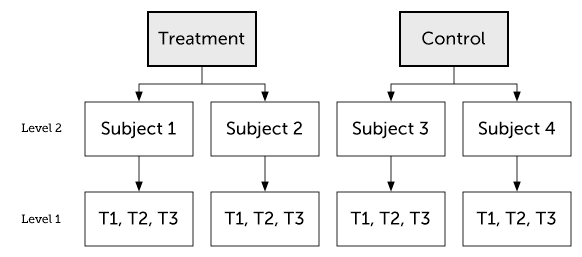
Unconditional model
Model formulation
with,
and
To fit this model we run
Unconditional growth model
Model formulation
with,
and
To fit this model we run
Conditional growth model
Model formulation
with,
and
To fit this model we run
Conditional growth model: dropping random slope
Model formulation
with,
and
To fit this model we run
Conditional growth model: dropping random intercept
Model formulation
with,
and
To fit this model we run
Conditional growth model: dropping intercept-slope covariance
Model formulation
with,
and
To fit this model we run
Three-level models
Here I will cover some different three-level models. In my examples clustering at the highest level is due to therapists. But the examples generalize to other forms of clustering as well, such as group therapy or clustering due to health-care provider. 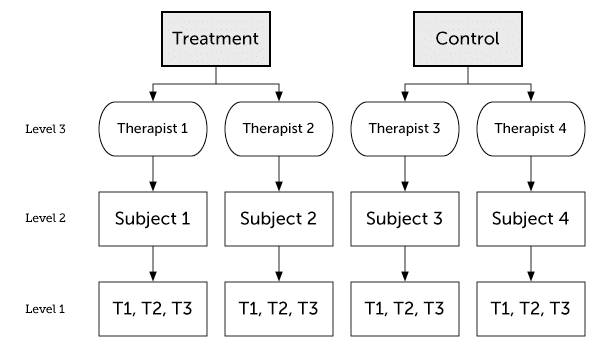
Conditional three-level growth model
We will jump straight to the conditional three-level growth model, with the following model formulation:
with,
and,
and
To fit this model we use therapist/subjects, which specifies nesting. This formula expands to a main effect of therapist and a interaction between therapist and subjects (which is the subject level effect).
Subject level randomization (therapist crossed effect)
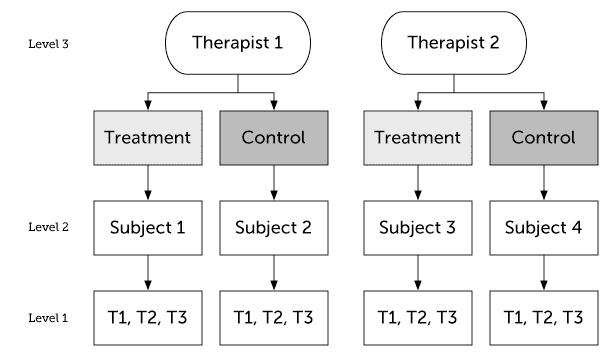
In the previous example therapists only provided one type of treatment (nested design). Sometimes therapists will be a crossed effect, i.e. in a parallel group design they will deliver both treatments. If it's a randomized trial then in this design we have subject level randomization, whereas in the previous example randomization was at the therapist level.
with,
and,
and
In this model we estimate no covariances at level 3. However, at the therapist level we have random effects for time, treatment and time treatment*. I fit this saturated model because you can easily delete a random effect in the expanded lmer syntax below.
Different level 3 variance-covariance matrix
We might hypothesize that therapists that are allocated participants that report worse symptoms at treatment start have better outcomes (more room for improvement). To allow for separate covariances in each treatment group we update the variance-covariance matrix at level 3
To fit this model we run
Of course, we could also estimate all six covariances at level 3. For instance, we could look at if therapists who are more successful with Treatment A are also more successful with Treatment B, i.e. , and so forth. The full unstructured level 3 variance-covariance matrix we will estimate is thus
Which we fit by running
Partially nested models
Partially nesting occurs when we have nesting in one group but not the other. For instance, we might compare a treatment group to a wait-list condition. Subjects in the wait-list will not be nested, but subjects in treatment group will be nested within therapists.
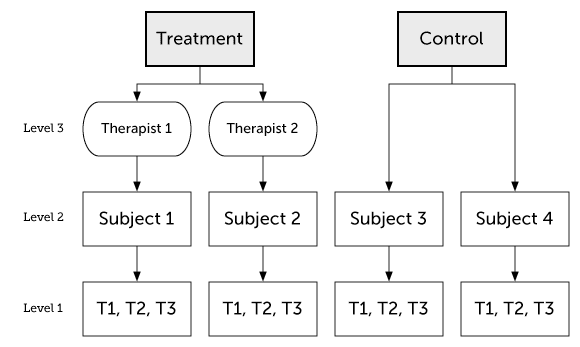
We can write this model like this
with,
and,
and
More on level 1 specification
Heteroscedasticity at Level 1
Only lme allows modeling heteroscedastic residual variance at level 1. If we wanted to extend our two level model and allow for different level 1 residual variance in the treatment groups, we'd get
If we wanted to extend our two-level model with this level 1 structure we'd run
More grouping
We could also add another grouping factor such as time, and fit a model with heteroscedastic level 1 residuals for each time point in each treatment group. For instance, for i = 0, 1, 2 we get
which we'd fit by running
First-order Autoregressive AR(1) residuals
For time points we get the level 1 variance-covariance matrix
we leads to
To fit this level 1 residual structure we use the correlation argument.
Heterogenous AR(1)
We can also extend the level 1 variance-covariance matrix from above, to allow for different residuals at each time point.
and we have that
To fit this level 1 model we simply use both the correlation and the weights argument.
More level 1 variance-covariances matrices
Se ?corClasses for the different types of residual variance-covariances matrices lme can estimate.
Changing the functional form of time
All of the examples above assume linear change. Here I will cover some examples of how to model nonlinear change at level 1. The examples will be based on the two-level model, but you could easily be combined them with the three-level models outlined above.
Quadratic trend
with,
and
Orthogonal polynomials
If you'd like to fit orthogonal polynomials you can use the poly() function with raw = FALSE (which is the default).
Piecewise growth curve
Segmenting the time trend into different pieces has got more to do with simple dummy coding of regression variables, than any specifics of lme or lmer. However, I will cover some common scenarios anyway.
To fit a piecewise growth model we simply replace time with two dummy variables time1 and time2, that represent the different time periods. A common scenario is that the first piece represents the acute treatment phase, and piece 2 represent the follow-up phase.
Coding scheme 1: separate slopes
| Time | 0 | 1 | 2 | 3 | 4 | 5 |
|---|---|---|---|---|---|---|
| Time 1 | 0 | 1 | 2 | 2 | 2 | 2 |
| Time 2 | 0 | 0 | 0 | 1 | 2 | 3 |
Coding scheme 2: incremental/decremental slope
| Time | 0 | 1 | 2 | 3 | 4 | 5 |
|---|---|---|---|---|---|---|
| Time 1 | 0 | 1 | 2 | 3 | 4 | 5 |
| Time 2 | 0 | 0 | 0 | 1 | 2 | 3 |
These two coding schemes only differ in the interpretation of the regression coefficients. In scheme 1 the two slope coefficients represent the actual slope in the respective time period. Whereas in scheme 2 the coefficient for time 2 represents the deviation from the slope in period 1, i.e. if the estimate is 0 then the rate of change is the same in both periods.
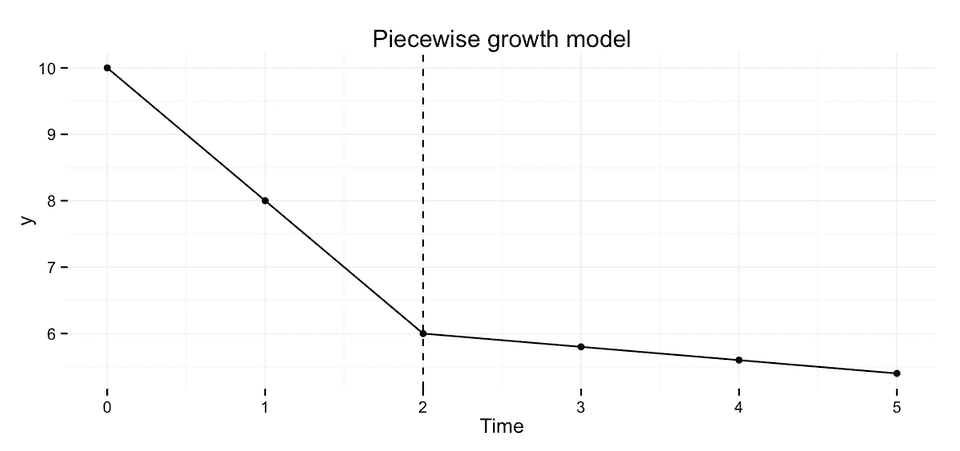
We could specify this model like this
with,
and
In this model I've fit the full level 2 variance-covariance matrix. If we wanted to fit this model we'd do it like this
Drop the correlation between time piece 1 and 2
Sometimes you might want to fit a model with a correlation between the random intercept and time piece 1, but no correlation between time piece 2 and the other effects. This would change the level 2 variance-covariance from above to this
Fitting this model is straight-forward in lmer and more complicated in lme.
Adding a quadratic effect
We could extend the two-part piecewise growth model to allow for non-linear change during one or both of the pieces. As an example, I'll cover extending the model to allow for quadratic change during piece 1.
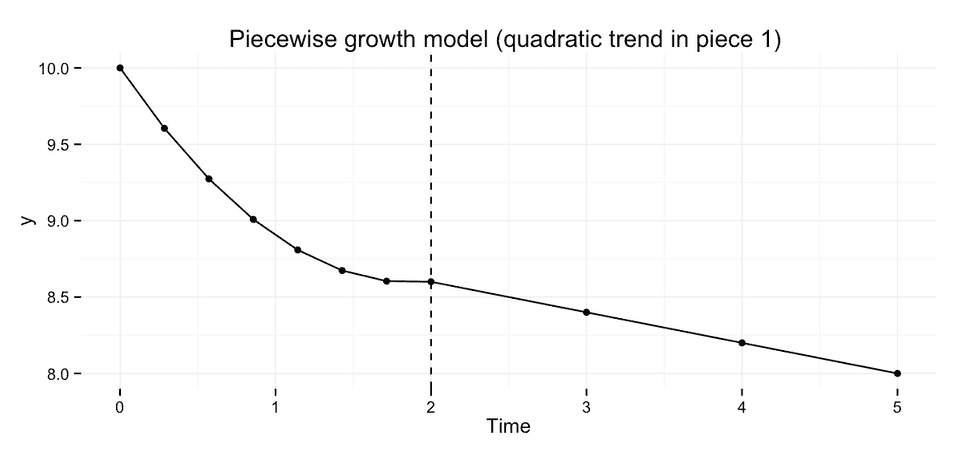
We could write this model like this
with,
and
This model could be fit like this
If you wanted to fit a reduced random effects structure you could use the method outlined in "Drop the correlation between time piece 1 and 2".
Hypothesis tests
lmer does not report p-values or degrees of freedoms, see ?pvalues and r-sig-mixed-models FAQ for why not. However, there are other packages that will calculate p-values for you. I will cover some of them here.
Wald test
Likelihood ratio test
Profile confidence intervals
Parametric bootstrap
Kenward-Roger degrees of freedom approximation
Shattertwaite degrees of freedom approximation
Book recommendations
Not all of these books are specific to R and longitudinal data analysis. However, I've found them all useful over the years when working with multilevel/linear mixed models.
Suggestions, errors or typos
Please don't hesitate to contact me if you find some errors in this guide.
Source: https://rpsychologist.com/r-guide-longitudinal-lme-lmer/
0 Response to "Continuous Piecewise Linear Mixed Effects Model Using R"
Post a Comment